Could mentoring become the next strand of your teaching career?
Level 1 - Foundations of Teacher-Mentoring is a practical course for experienced singing teachers, vocal coaches, voice teachers, choir leaders and course leaders.
Learn how to turn the support you already give other teachers into a skilled, structured professional mentoring service.

The problem
Other teachers already ask for your help
But mentoring is not simply giving better advice. The real skill is knowing when to listen, when to question, when to challenge and when a practical suggestion will genuinely help.
Move too quickly and you can solve the wrong problem, overwhelming the teacher or taking over a decision that belongs to them.
Stay too vague and the conversation may feel supportive but lead nowhere.
This course helps you find the useful middle ground.
Built from real-world mentoring experience
Foundations of Teacher-Mentoring grew from detailed analysis of 64 real mentoring sessions representing more than 50 hours of professional mentoring practice.
In those sessions, singing teachers and vocal coaches brought genuine professional questions, decisions and challenges to the three tutors, Jeremy Fisher, Dr Gillyanne Kayes and Anne Leatherland.
The analysis revealed the principles beneath their different mentoring styles and turned those principles into a practical process you can study, test and apply


Practical training you can use straight away
Instantly available video training and more than 20 downloadable resources

Live sessions for you to practise the techniques under supervision
Three 90-minute live teaching and discussion sessions with the tutors, plus one hour-long Q&A

Neuroinclusive learning resources and evaluations
Short videos of each section's overview & live event recordings. Assessed quizzes and reflective tasks
What you will learn
Moving from informal advice to skilled mentoring
You will learn how to:
- Hear the real question beneath the first question
- Separate evidence from assumption
- Sort complex situations without trying to solve everything at once
- Choose the next useful mentoring move
- Use questions, challenge, feedback and advice with better judgement
- Set clearer boundaries and recognise when referral may be needed
- Support another teacher without taking responsibility for their decisions
- Notice your own mentoring strengths and predictable blind spots
This is not advanced vocal technique training or therapy training. It is foundational training in the professional judgement needed when one teacher supports another

Jeremy Fisher
A highly experienced performer, coach and creator, Jeremy’s mentoring is dynamic, diagnostic and action-focused. He quickly identifies the problem beneath the presenting issue, clarifies where responsibility lies and turns complexity into a usable structure. His direct questions, precise distinctions and humour expose muddled thinking, unnecessary work and undervaluing. Drawing fluidly on pedagogy, performance and business, he builds confidence through specificity. His mentees leave with clearer language, practical next steps and a stronger sense of what is, and is not, their job.

Dr Gillyanne Kayes
Gillyanne’s mentoring is analytical, reflective and developmental. She helps mentees organise complexity, separate what is known from what is assumed, and recognise learning as a progression rather than a demand for instant mastery. She often privileges embodied experience and observation before explanation, allowing understanding to emerge from evidence. Her strength-based reframing supports both sound judgement and practitioner sustainability. Rather than supplying a quick answer, she creates the conditions in which mentees can think more clearly and reach well-founded conclusions.

Anne Leatherland
Anne’s mentoring is relational, pragmatic and sensitively calibrated to the person in front of her. She notices emotional state, confidence and available capacity before deciding what kind of intervention will help. Warm containment and purposeful professional self-disclosure allow her to translate emotion into manageable action without rescuing or lowering standards. She combines compassion with clear expectations, adjusting pace and pressure while maintaining forward movement. Her approach helps mentees feel understood, regain perspective and identify a realistic next step they can genuinely sustain.
Working with Jeremy, Gillyanne & Anne
"I struggle to filter through the millions of thoughts when looking for succinct ways of explaining what I offer as a teacher. I love the space to be able to talk this through with Jeremy and Gillyanne. It's really useful as they see me and what I offer more clearly"
Grace with Jeremy & Gillyanne
"Realising how small I have made myself is quite a shock. There is no judgement from Anne. She creates a safe and supportive place for you to grow and heal"
Colette with Anne
"The reassurance of the way I was feeling was acceptable and that my decisions to advance my career in the direction I am taking was not ludicrous. Clear direction with how to begin to move forward with my development"
Steven with Jeremy
"To be able to talk to someone who has such a holistic understanding for the voice and artists is excellent, and then to gain clear, concise instructions/exercises for the issues I am having around my voice feels like I'm not alone and am empowered"
Celestine with Gillyanne

Course Curriculum
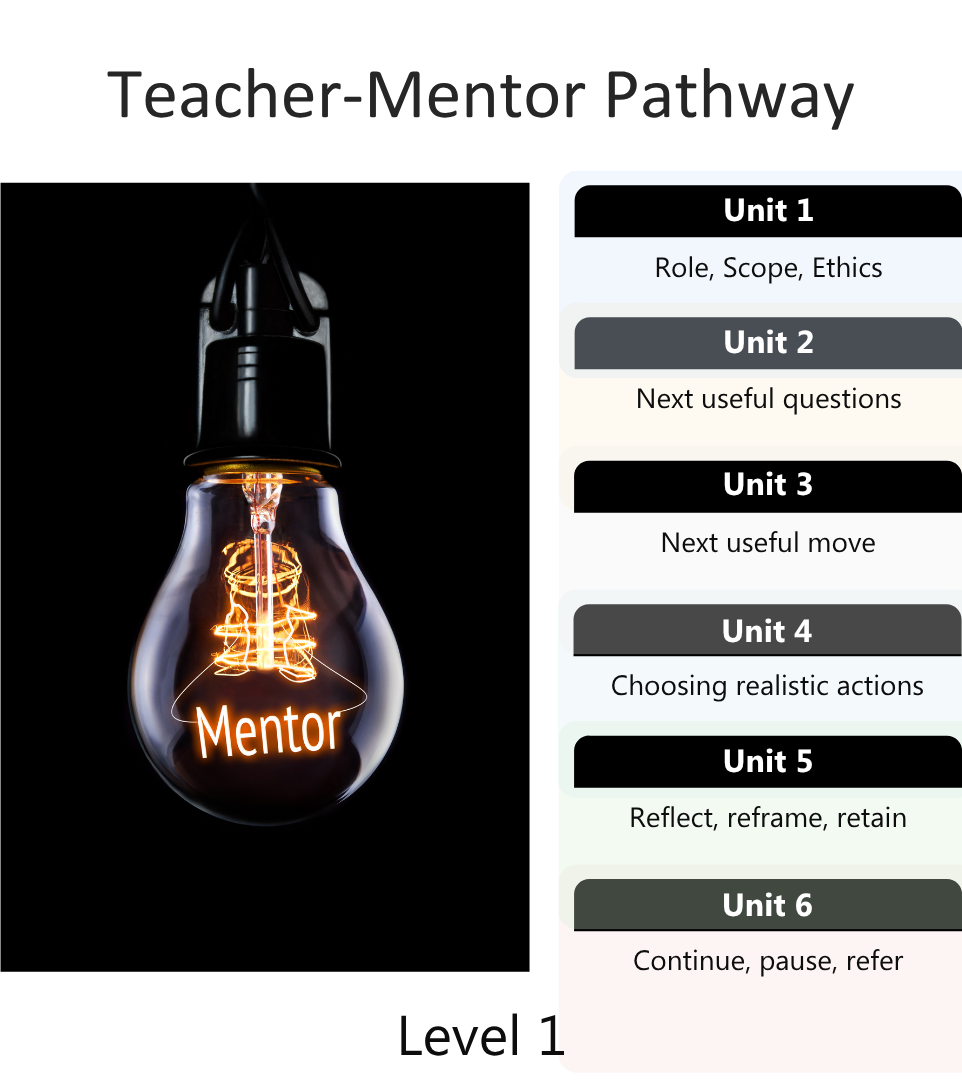
Level 1 takes you through SIX connected areas of teacher-mentoring.
Each unit combines concise teaching with practical handouts, reflection exercises and application
Begin with the free quiz - What Kind of Teacher-Mentor Are You?
Then join the cohort for Level 1, beginning 14th September 2026
Unit 1 - What Mentoring Is, and What It Is Not
Unit 2 - Contracting, Listening and Finding the Real Agenda
Unit 3 - Sorting Complexity and Choosing the Next Useful Move
Unit 4 - Capacity Calibration: State Before Strategy
Unit 5 - Feedback, Reframing and Useful Challenge
Unit 6 - Boundaries, Reflection and Peer Mentoring
PLUS Live online sessions for practice and feedback

FAQs
You might be wondering...
Do I need to be mentoring already?
No, you may already be supporting colleagues informally, or you may be exploring mentoring for the first time
How experienced do I need to be?
Around ten years of teaching experience is recommended, but it is not a strict entry requirement. The course is designed for established voice professionals.
Is Level 1 too basic for an experienced teacher?
Level 1 does not teach basic vocal technique. It develops listening, boundaries, role clarity and professional judgement in complex conversations.
What if I can't attend live?
Live attendance is recommended, but every session will be recorded and available until 14th December 2026
Will this qualify me as a Vocal Process Mentor?
You will receive a Vocal Process Certificate of Completion if you meet the requirements. Level 1 develops foundational skills and prepares you for further development. It does not grant Vocal Process Mentor status or guarantee clients
Example Featured Products
Showcase other available courses, bundles, and coaching products you’re selling with the Featured Products block to provide alternatives to visitors who may not be interested in this specific product.